Myxomatosis epidemic among British rabbits
H is for HawkThe Myxomatosis epidemic among British rabbits was a rapid, human-mediated ecological disaster whose effects extended beyond the animals it killed. The virus arrived in Britain in 1952 and, within two years, killed 95 per cent of the rabbit population. In Helen’s account, that historical collapse returns not as a remote statistic but through a sick rabbit by the roadside, connecting a present act of care to a childhood shaped by fears that the natural world was failing.
Arrival and Scale
Myxomatosis originated in South America and had already been introduced by humans to Australia and Europe before reaching Britain. Its arrival in 1952 began a devastating decline: ninety-five per cent of British rabbits died within two years. The speed and scale of that loss made the disease more than a local episode. Tens of millions of dead rabbits were left across roads and fields, a mass mortality that transformed familiar countryside as well as the population of a single species.
The epidemic’s consequences were not confined to the visible dead. Rabbit-grazed grasslands grew thick with scrub after the animals that had kept vegetation cropped were largely gone, while predator populations crashed. Rabbits later recovered, but never to the numbers people had once regarded as normal. The disease also became less virulent, though outbreaks continued. Recovery, in this account, is therefore incomplete: the return of rabbits does not restore the former abundance or erase the ecological changes caused by their sudden disappearance.
A Sick Rabbit and an Inherited Memory
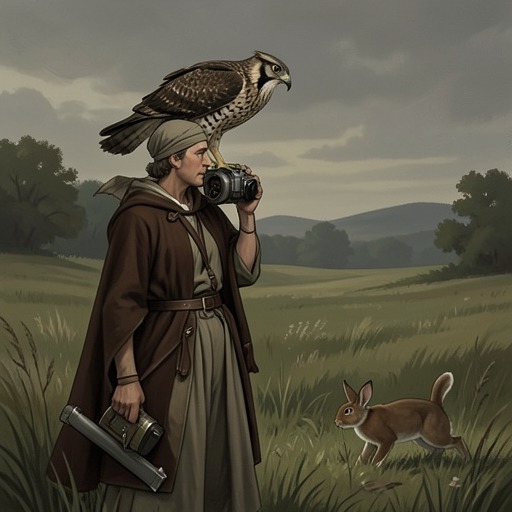
Years later, Helen sees a group of walkers gathered beside a rabbit on a grassy verge. They recognize that it is sick and want to help, but no one knows what to do, and none of them approaches it. After they leave, Helen goes to the animal and recognizes that it has myxomatosis. She ends its suffering. The moment places individual responsibility beside a disease operating at population scale: the walkers’ concern cannot reverse the epidemic or treat its cause, but Helen’s response addresses the suffering of the one animal in front of her.
The rabbit stays in her mind as something returned from the past. Its presence recalls the countryside crisis Helen experienced as a child, when rabbits were dying and other signs of environmental damage accumulated around her: hawks declining under agricultural pesticides, elm trees being cut down and burned, otters gone, rivers poisoned, and guillemots drowning in polluted seas. The rabbit’s illness thus carries more than the history of myxomatosis. It revives an early apprehension that environmental damage was widespread and might ultimately reach human life too.
That childhood fear included the prospect of nuclear destruction. Helen remembers asking her parents whether the family should build a fallout shelter beneath the garden, and being told that their house was close to military targets and would be destroyed immediately in a war. She buried pieces of slate bearing her name, hoping that something might survive. The memory places the epidemic beside a broader childhood expectation of catastrophe, while preserving a distinction between them: myxomatosis is a documented ecological disaster, whereas nuclear annihilation was the feared future through which she understood the vulnerability of the world around her.
Ecological Change and the Moving Baseline
The epidemic provides a stark example of how a change can become difficult to see once people grow accustomed to its aftermath. Rabbits recovered, but at a level lower than the abundance later remembered as normal. That altered baseline matters because the countryside may appear to have returned to familiar form while its populations and ecological relationships remain changed. In Helen’s account, an apparent return is not the same as restoration.
The same problem shapes her later reflections on agricultural land. Fields can retain the outward signs of countryside while offering fewer plants, bees, and butterflies because the soil is treated with chemicals. Memories and records reach further back than any one observer’s lifetime: turtle doves were present ten years earlier, corn buntings and large flocks of lapwings thirty years earlier, and red-backed shrikes, wrynecks, and snipe seventy years earlier. Ravens and black grouse belonged to the landscape two hundred years before. All are gone from the fields she describes. These losses are not consequences attributed to myxomatosis; rather, they extend the epidemic’s significance by showing how ecological change accumulates across different causes and species, while the familiar appearance of land can conceal its impoverishment.
Significance in the Narrative
The rabbit’s illness makes the epidemic legible through a small encounter, then opens onto the much larger history of ecological loss. The movement is from a single animal to the remembered mass death of rabbits, and from that remembered event to a landscape altered by several generations of change. By connecting the roadside rabbit to her childhood memories, Helen shows how grief and attention can recover older ways of seeing that later ideas of normality have obscured.
The episode also complicates nostalgia for an imagined, stable countryside. What seems familiar may already be the product of earlier losses: rabbit numbers have not returned to their former level, and other species have disappeared from fields that still look rural. The epidemic is therefore both a particular historical event and a measure of how people remember nature. Its aftermath demonstrates that survival, visual continuity, and ecological recovery are not interchangeable—and that present landscapes cannot be understood by looking only at what remains.